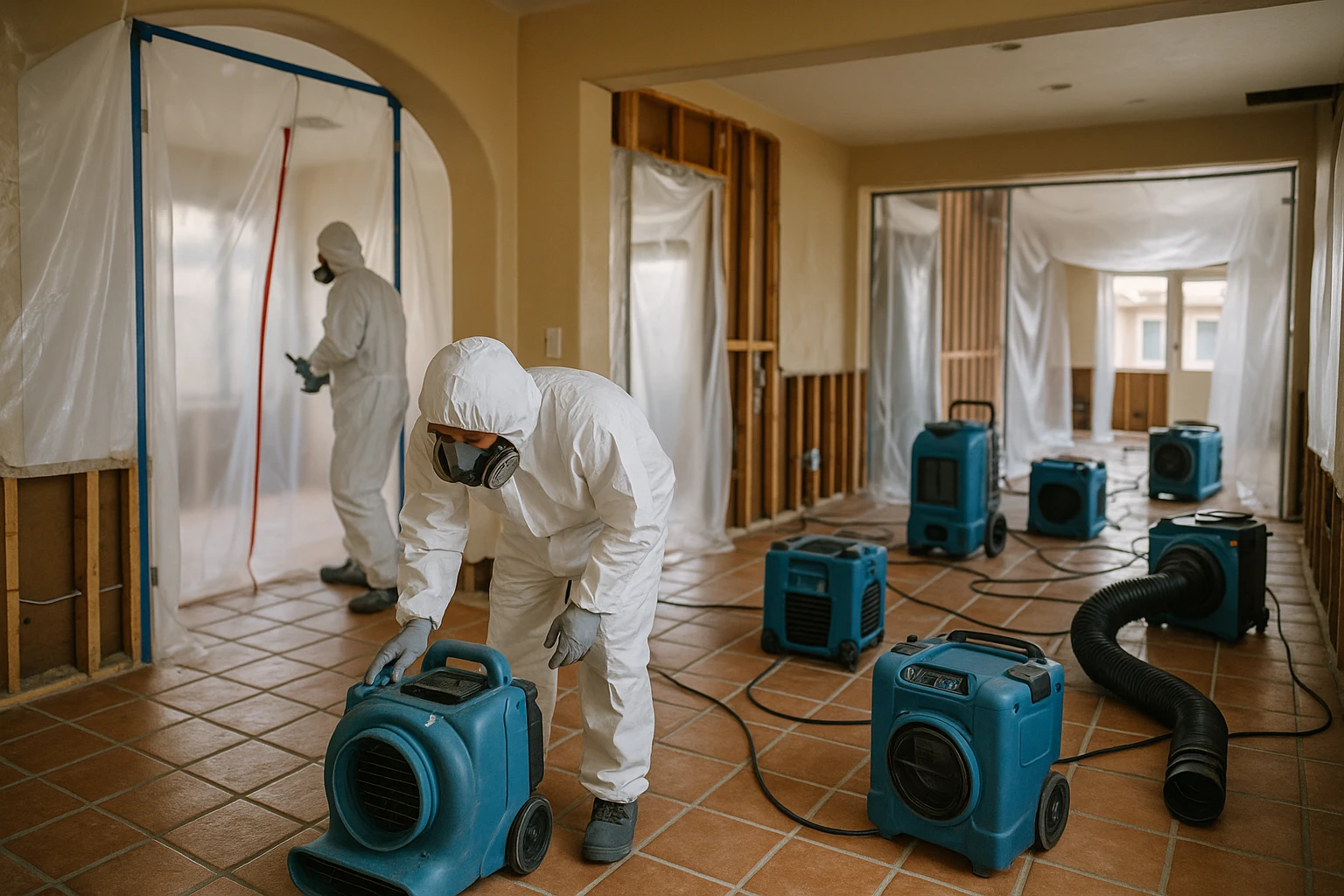
When one problem becomes a whole-house problem
Most mold calls are about a single spot — a vanity, a closet, a ceiling stain. Whole-home remediation is different in kind, not just degree. It's what's needed when moisture has spread through the structure and surfaced in multiple places: mold in two bathrooms and a hallway, staining along the base of several walls, mustiness in rooms that share no plumbing. In El Paso, the underlying cause is almost always one of a few things working slowly over time — a slab leak feeding several walls, a swamp cooler seeding multiple rooms through the ducts, or an old flood or roof leak that was patched cosmetically without ever drying the structure.
The El Paso causes that go whole-home
- Slab leaks: a pressurized line under the slab can wick moisture into the bottom of walls across a large footprint before anyone connects the dots.
- Swamp-cooler distribution: a contaminated cooler pushes spores through every duct run, so growth appears in rooms throughout the house at once.
- Unfinished flood drying: a home flooded in a past monsoon and rebuilt quickly — new lower drywall over framing that was never dried — harbors slow-burning mold behind the patch.
- Rising damp in valley homes: in Lower Valley and Upper Valley properties with high groundwater, moisture migrates up block and adobe walls across the whole structure.
Why these projects start with diagnosis
The mistake that makes whole-home mold expensive is treating the visible patches one at a time while the shared source keeps feeding new ones. A proper project starts with a comprehensive inspection: moisture mapping across the entire home, infrared scanning to find wet cavities, and sampling to understand what's growing and where. The goal is a single coherent picture — one source, mapped to every place it has reached — so the remediation scope is complete the first time. Independent diagnosis matters even more here, because the larger the job, the bigger the incentive to over- or under-scope it.
How whole-home remediation is staged
A multi-room project is sequenced to protect the parts of the house that are still clean while the affected zones are worked. Crews establish containment zone by zone, run negative air so spores don't migrate, and often work the home in sections so the family can stay or relocate temporarily as needed. The core steps are the same as any remediation — fix the source, contain, remove porous materials, HEPA-clean and treat, dry to a verified moisture content, and rebuild — but the coordination is the hard part. Plumbing repairs, duct cleaning, drying equipment, and demolition all have to be choreographed across rooms, and an independent clearance test at the end confirms the whole house, not just one room, is back to normal.
Living through a larger remediation
Homeowners reasonably worry about whether they can stay during the work. The answer depends on the footprint and where the family sleeps relative to the active zones. Good containment means much of the house stays usable, but during the dustiest demolition phases — or when the affected areas include bedrooms or the only bathroom — staying elsewhere for a few days is often the comfortable choice. A reputable crew will tell you honestly which phases are disruptive and plan the sequence to minimize how long any essential space is offline.
Cost, insurance, and getting it right once
Whole-home projects span a wide range because they hinge on the source and the spread. A slab leak caught after it reached a few walls is far less than an old, undried flood that has compromised framing across the house; multi-system projects commonly land in the five-figure range, and the structural end runs higher. Where the trigger was a sudden, covered water event, parts of the work may be insurable — our insurance guide explains how the mold exclusion interacts with covered losses. Either way, the cheapest version of a whole-home project is the one you catch early, before a single source has had years to spread. If mold is showing up in more than one room of your El Paso home, the right next step is a comprehensive inspection. Get matched with an independent local pro who can map the whole house and build one plan to fix it.