The West El Paso moisture picture
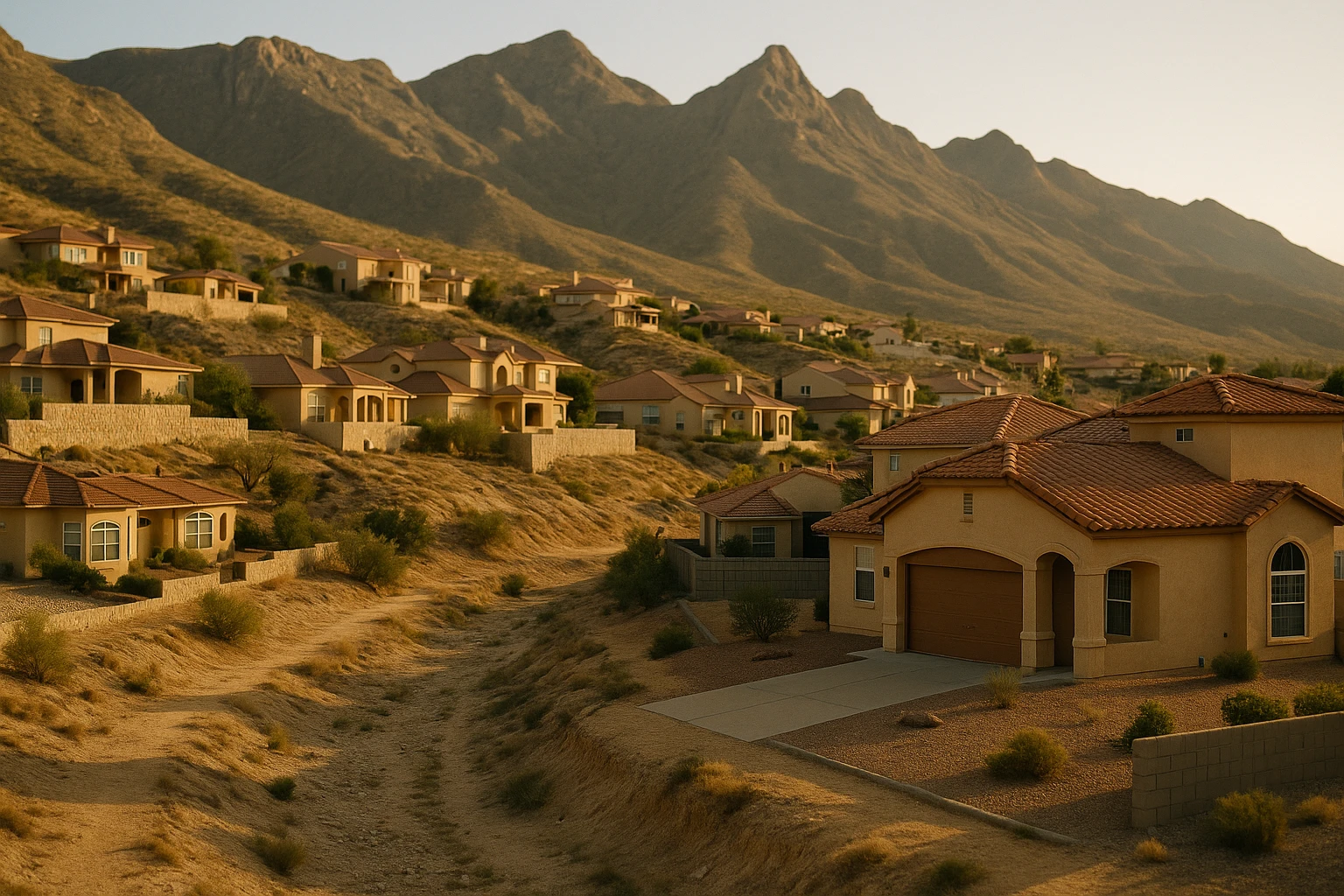
West El Paso climbs the western slope of the Franklin Mountains, taking in established neighborhoods like Coronado, Mission Hills, Kern Place, and the newer developments pushing up the foothills toward the edge of the range. It's prime real estate, with mountain views and mature trees, but the same topography that makes it beautiful concentrates water. During monsoon storms, rain that falls on the Franklins doesn't soak in — the rocky soil sheds it — and it races down arroyos and streets straight through these foothill neighborhoods. The Mesa and Kern Place areas have made the news more than once for streets turning into rivers when a slow-moving cell stalls over the mountains.
That gives West El Paso two distinct mold pathways: sudden water intrusion from storm runoff, and the everyday moisture of swamp coolers and plumbing in a housing stock that ranges from 1920s Kern Place bungalows to 2020s hillside builds. Both produce mold; they just hide it in different places.
Foothill runoff and flash flooding
The defining Westside risk is how fast water arrives. Homes built into or below the foothills can take runoff that has gained speed and debris coming off the mountain, entering through garage thresholds, low windows, and doors during the heaviest storms. Because the soil and rolling terrain shed water so quickly, even a brief but intense downpour can put water where it's never been before. When that happens, the clock starts: mold can begin in soaked drywall and carpet pad within 24 to 48 hours, and the heat dries surfaces deceptively fast while the material underneath stays wet. Our monsoon water-damage page covers the response in detail.
Older Kern Place and Mission Hills homes
The character homes of Kern Place, Mission Hills, and Sunset Heights bring their own moisture quirks. Many are eighty to a hundred years old, with original plumbing that develops slow leaks, flat or low-slope roofs that pond and leak at the parapets, and block, brick, or stucco walls that wick groundwater at grade. Decades of renovations can hide moisture barriers that no longer work and additions that were never properly flashed. Mold in these homes tends to show up at the base of walls, under sinks, and on ceilings below the roofline — the quiet result of small, long-running leaks rather than a single dramatic event.
Common West El Paso mold issues
- Storm intrusion around garages, low windows, and doors when foothill runoff overwhelms drainage.
- Flat-roof and parapet leaks on older Mesa-area and Kern Place homes that surface as ceiling stains.
- Swamp-cooler mold distributed through ducts in homes that still rely on evaporative cooling.
- Slow plumbing leaks in aging original plumbing, wicking into walls and slab edges.
- Slab and supply-line leaks in newer hillside builds where the problem hides for weeks before it shows.
What to do if you suspect mold here
Start with the water, not the stain. Because Westside causes range from a sudden storm to a decades-old roof, the first question is always “where is the moisture coming from?” A licensed local inspector can map it — storm intrusion, roof, slab, or cooler — and document it for insurance if a covered event was involved. From there, remediation follows the standard containment-first sequence: fix the source, seal the area, remove unsalvageable porous materials, treat and dry, and verify. We connect West El Paso homeowners with independent inspectors and licensed remediation crews who know the foothill drainage patterns and the quirks of both the historic and the new housing stock. Explore inspection, swamp-cooler, and storm-damage services, or sketch a budget with our cost estimator.
After the storm, check before it spreads
If your Westside home has taken water in any recent monsoon season — even if it dried and seemed fine — it's worth confirming that moisture didn't stay trapped behind rebuilt walls or under flooring. Hidden, slow-burning mold from an old intrusion is exactly the kind of thing a local inspector can rule in or out before it becomes a larger project. After a hard storm, a quick check of garage walls, low rooms, and top-floor ceilings is cheap insurance. If anything smells musty or looks stained, get matched with a licensed local pro for a free, no-pressure assessment.
What drives mold in West El Paso
If there's a single thing to understand about mold in West El Paso, it's arroyos that funnel monsoon runoff straight off the Franklin Mountains into foothill yards and garages. Hillside lots can send sheet-flow against a downhill wall during a storm, so the moisture often enters low and migrates up inside the wall. That's why a real fix here starts with identifying the moisture source rather than scrubbing the visible spot — in a desert, the stain is just where the water finally showed itself, and it's usually lower and wider inside the wall than it looks on the surface.
Local housing stock matters too. West El Paso is a mix of mid-century foothill homes and newer hillside builds, and the construction shapes how mold behaves. The practical lesson for homeowners around Coronado, Mission Hills, Kern Place, and Sunset Heights is that a musty smell or a small stain almost always has a findable cause behind it — and once that cause is stopped and the cavity is properly dried, the problem genuinely goes away rather than returning in a few weeks.
Getting help in West El Paso
We connect West El Paso homeowners — across ZIP codes 79902, 79912, and 79922 and the surrounding area — with licensed, independent local professionals who know how desert homes hold water. The process is simple: tell us what's going on, we match you with a pro suited to your situation, and you get a free, no-pressure assessment. There's no obligation and the service is free to you. If you've had recent flooding or water is still coming in, call right away, because in West El Paso's climate the surface dries fast and hides how wet the structure underneath still is.