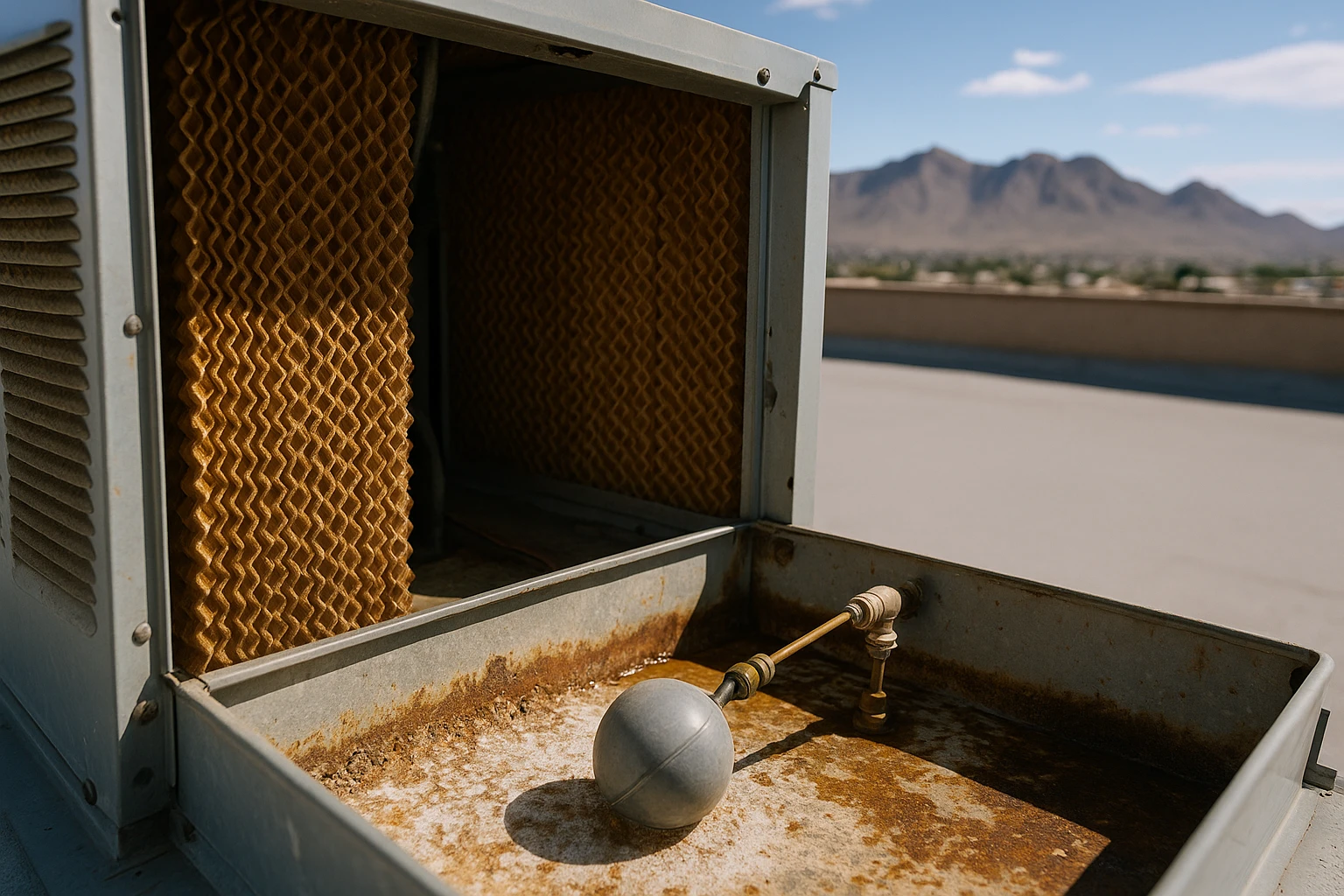
Why swamp coolers are El Paso's biggest mold driver
Most of the country worries about humidity getting into a house. In El Paso, a lot of us deliberately pump it in. An evaporative cooler — a “swamp cooler” — works by drawing hot, dry desert air through water-soaked pads; the water evaporates, the air cools, and that newly humid air is blown through the house. It's cheap, efficient, and perfect for a climate that's usually under 15% humidity. It also means that for several months a year, your cooling system's entire job is to add water to your indoor air.
That's fine when everything is clean and draining properly. The trouble starts when the pads stay soggy between cycles, the reservoir pan grows algae, the bleed-off line clogs, or humid air condenses on cool sheet-metal ducts. Each of those creates exactly the damp, organic environment mold needs — and because the unit blows air into living spaces, a moldy cooler doesn't just smell musty, it actively distributes spores into every room it serves.
Signs your cooler is feeding mold
- A musty or “dirty sock” smell that hits hardest when the cooler first kicks on.
- Dark streaking on vents, ceilings, or the wall directly below a ceiling diffuser.
- Damp or stained drywall around the cooler's duct chase or downdraft opening.
- Allergy or asthma symptoms that worsen during cooling season and ease in winter.
- Visible algae or slime in the cooler pan when you open it for spring start-up.
What removal and cleaning involve
Swamp-cooler-related mold is really two problems: the contamination inside or around the cooling system, and any mold that the system has already seeded into rooms and wall cavities. A licensed crew typically addresses both. At the system, that means cleaning or replacing pads, scrubbing and disinfecting the pan and water distribution, clearing the bleed-off and overflow lines, and HEPA-cleaning the duct runs the unit feeds. Where humid supply air has been condensing on metal ducts, insulation may need replacement and the duct chase may need drying and treatment.
In the living space, remediation follows the standard path: contain the affected area, remove porous materials that have grown mold (stained drywall, ceiling tile, soaked insulation), HEPA-vacuum and wipe down surfaces, treat with an antimicrobial, and dry everything to a measured moisture content. Because the duct system is the highway that spread spores in the first place, cleaning it is often essential to keep the problem from simply reappearing.
Refrigerated air isn't automatically safe
Plenty of El Paso homes have converted from swamp coolers to refrigerated air, and newer builds increasingly come with central AC from day one. Refrigerated systems don't add humidity, but they create their own mold path: the cold evaporator coil condenses water, which drains through a condensate pan and line. When that line clogs — common when it's never serviced — the pan overflows into the air handler closet or attic, and mold blooms on the coil, the plenum, and the surrounding drywall. So whether you cool with a swamp cooler or a condenser, the cooling system is a prime suspect any time a home smells musty. Our prevention guide walks through keeping either system dry.
Seasonal timing matters in El Paso
Swamp-cooler mold is seasonal in a way that catches people off guard. The unit sits idle and dry all winter, then gets fired up in spring — and the first warm weeks are when a neglected pan, last year's pads, and a summer of dust combine into a fast bloom. Spring start-up is the ideal moment to clean and inspect, before the system runs daily for months. The second danger window is monsoon season, July through September, when outdoor humidity climbs and the cooler both works less efficiently and adds moisture to air that's already damp. Many El Paso homeowners switch cooling strategies during monsoon weeks for exactly this reason.
What it costs and what to do next
Cleaning a cooler and its ducts is far cheaper than remediating rooms it has already contaminated, which is the whole argument for catching it early. A straightforward cooler-and-duct cleaning is a modest service call; full remediation that involves removing stained drywall, replacing duct insulation, and clearing several rooms scales with the affected square footage, typically in the porous-material range. If your home smells musty when the cooler runs, the right first move is an inspection that checks the unit, maps moisture in the duct chase, and samples the air the system is delivering. We connect homeowners across El Paso — from the Westside to the Eastside and out to Horizon City — with independent pros who understand how local cooling systems drive local mold.