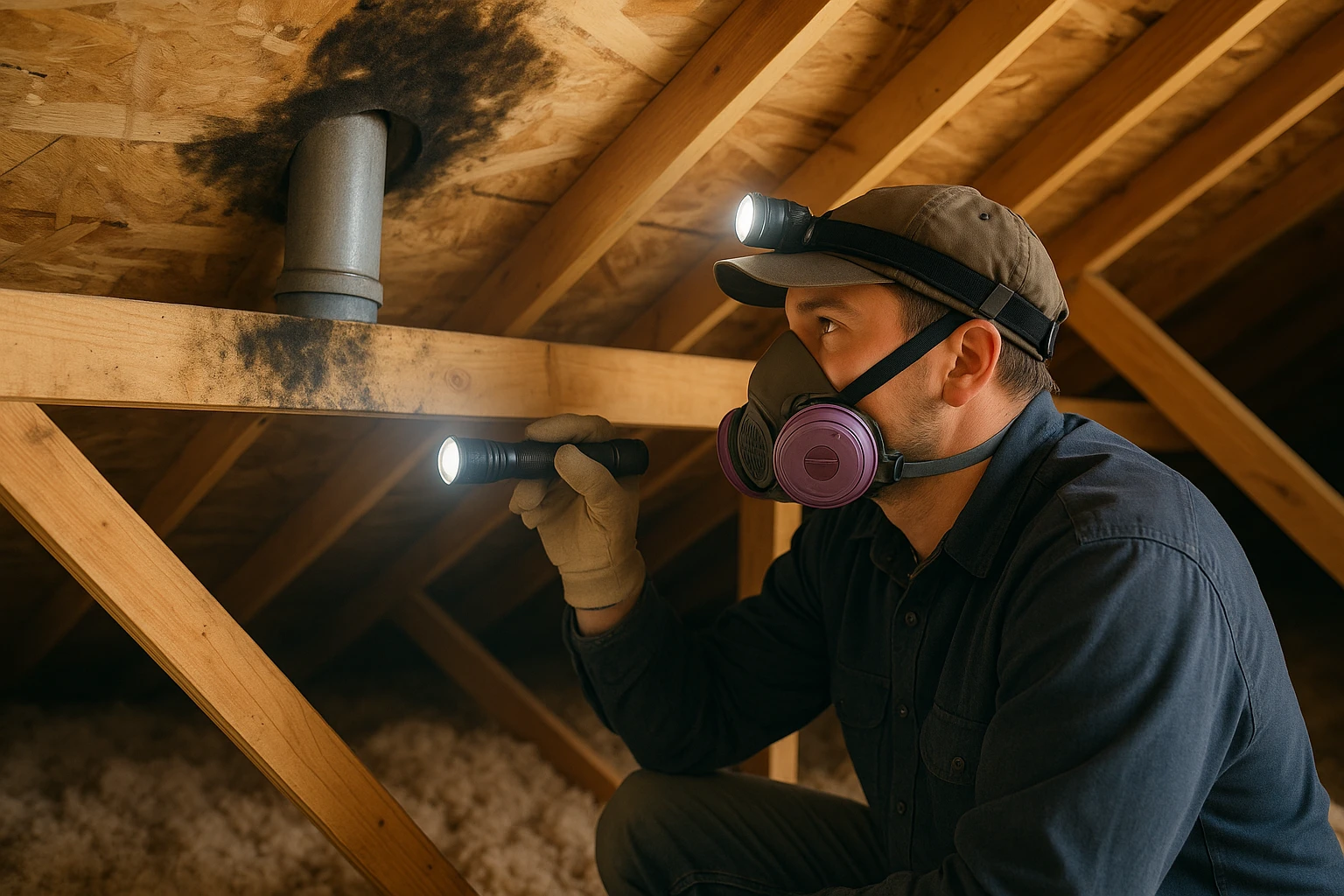
Why El Paso attics grow mold at all
An attic in a desert climate sounds like the last place mold would appear, and for most of the year it is. The problem is concentrated water and a handful of design quirks. Monsoon storms drive rain under flashing, around roof penetrations, and into the parapets of flat and low-slope roofs; the water tracks along framing and soaks sheathing and insulation in spots far from where it entered. Separately, swamp coolers and bath fans push warm, humid indoor air upward, and when that moisture-laden air hits the cool underside of the roof deck on a winter night, it condenses — the same way a cold glass sweats. Repeated condensation feeds mold on the sheathing and the tops of the trusses.
The bath-fan and cooler-duct problem
A surprising share of El Paso attic mold traces to ventilation that dumps moisture in the wrong place. Bathroom exhaust fans are supposed to vent humid air all the way outside; in many homes they simply blow it into the attic, where it has nowhere to go. Add a swamp cooler whose ducting runs through or terminates near the attic, and you've got a steady supply of damp air collecting against cold framing. Over a few seasons, that shows up as gray-black staining across the sheathing, mustiness you notice when you open the attic hatch, and sometimes insulation that's matted and discolored. Fixing the mold without fixing the ventilation just resets the clock.
What attic remediation involves
Attic work is awkward and dusty, and doing it right means more than wiping wood. A typical licensed-crew sequence:
- Diagnose the moisture. Roof leak, condensation, or mis-vented fan — the fix is different for each, and skipping this step guarantees regrowth.
- Contain and protect. Seal the attic access and the duct registers below so spores and debris don't rain down into the living space.
- Remove unsalvageable materials. Mold-laden insulation comes out; it can't be cleaned.
- Treat the structure. HEPA-vacuum and wipe the sheathing and framing, then apply an antimicrobial; heavily stained wood is sometimes media-blasted to bare timber.
- Correct ventilation. Re-route bath fans to the exterior, improve attic airflow, and address the cooler ducting so moisture stops accumulating.
- Re-insulate and verify. New insulation and, ideally, a clearance check.
Flat roofs and the El Paso roofline
A lot of El Paso housing — especially older Central and Lower Valley homes and Southwestern-style builds — has flat or low-slope roofs. Those roofs are wonderful for the architecture and tough on water management. They pond rainwater, rely on parapet flashing and interior drains that clog, and leak in ways that don't announce themselves until a stain spreads on a ceiling below. Because the “attic” space under a flat roof is often a shallow, hard-to-access cavity, mold there can be advanced before anyone notices. After every significant monsoon storm, it's worth checking ceilings on the top floor for fresh staining — the earliest warning that water found its way in.
Catching it before it spreads
Attic mold has a head start because nobody visits the attic casually. A few signs are worth acting on: a musty smell when the attic hatch opens, dark blotches on the underside of the roof deck, frost or water droplets on nails and sheathing in winter, ceiling stains after storms, and unexpectedly high cooling bills from wet, ineffective insulation. Any of these justifies a look. An inspection with an infrared camera can find the wet zones quickly and tell you whether you're dealing with a contained leak or a whole-deck condensation problem.
What it costs and next steps
Attic remediation pricing depends on access, square footage, and how much insulation and sheathing must be removed. A small, contained leak area is a relatively modest job; a whole-attic condensation problem with full insulation replacement and ventilation corrections costs more and overlaps with roofing and HVAC work. Because the moisture source is usually a roof or ventilation defect, attic mold is one of the clearest cases where fixing the building comes first and the mold cleanup follows. If you've noticed any of the warning signs — or just want peace of mind after a hard monsoon season — we can connect you with independent attic and remediation pros across East, West, and Central El Paso and the surrounding valley.