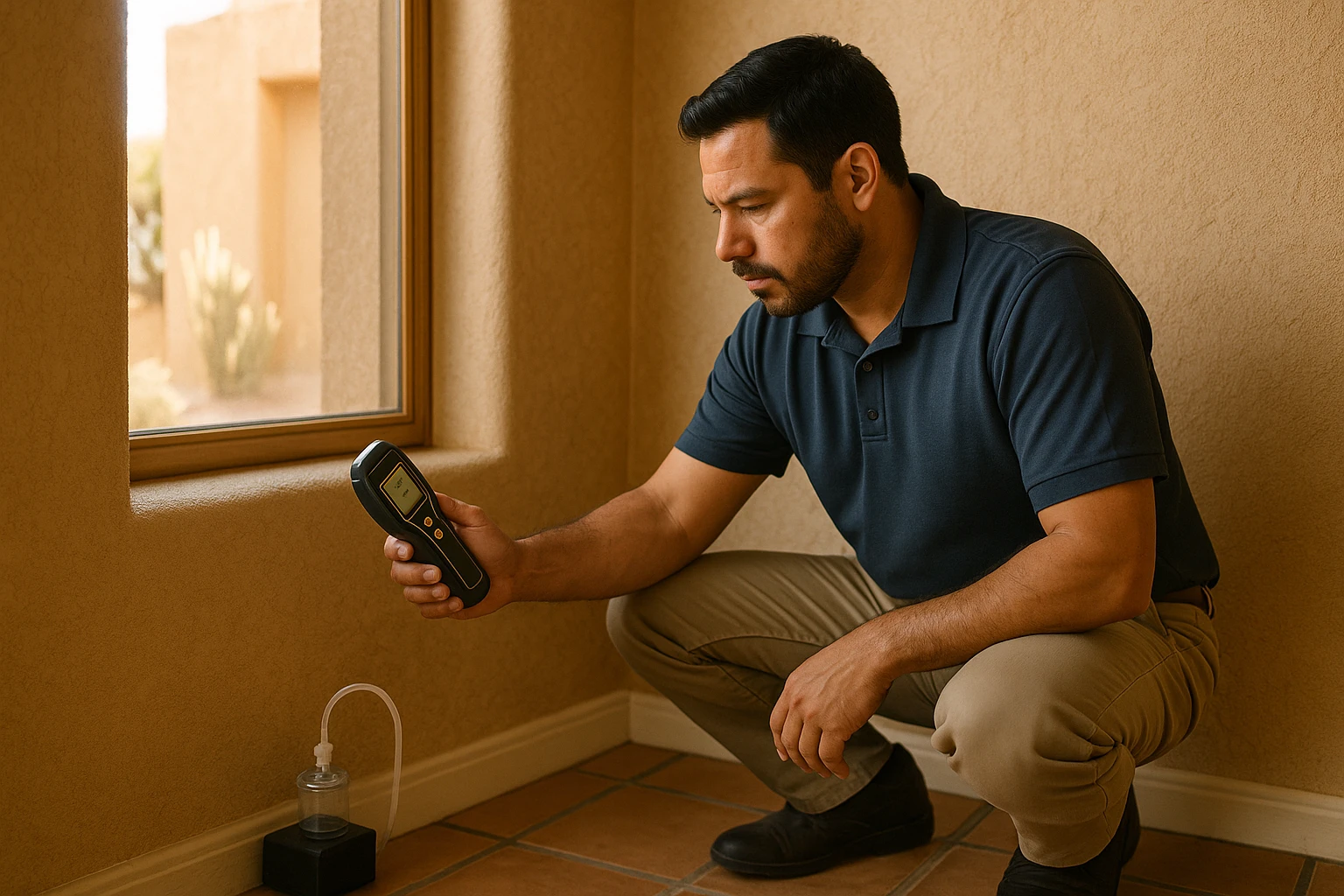
Why testing matters more in a desert house
El Paso sits in the Chihuahuan Desert at about 3,800 feet, with single-digit humidity for much of the year. That makes a lot of homeowners assume mold is impossible here — and it's exactly why mold here is so easy to miss. Desert mold rarely spreads as a fuzzy patch across an open wall the way it does on the Gulf Coast. It grows in pockets: behind a vanity fed by a slow supply-line drip, inside the wall under a swamp-cooler line, along a slab crack where a pinhole leak wicks upward. By the time it reaches the painted surface where you can see it, it has usually been growing in the cavity for weeks.
An inspection is how you find that hidden growth before it becomes a demolition project. A licensed inspector doesn't guess from the stain on the wall; they read moisture, map where it's coming from, and — when it matters — sample the air and surfaces so a lab can confirm what's actually there.
What a real mold inspection includes
The independent inspectors we connect El Paso homeowners with generally work through a consistent sequence:
- Visual survey. A room-by-room walk looking for staining, warping, efflorescence on block and adobe walls, and the tell-tale streaks below swamp-cooler vents.
- Moisture mapping. Pin and pinless meters plus an infrared camera to find wet drywall, slab moisture, and cold spots where condensation collects — the map points to the water source, not just the symptom.
- Humidity and dew-point readings. Especially around evaporative coolers, which can push indoor humidity from 15% to over 60% on a hot afternoon.
- Air sampling. Spore-trap samples indoors compared against an outdoor baseline, so the lab can tell whether your indoor counts are elevated relative to El Paso's normal desert air.
- Surface and tape lift sampling. Direct samples from suspect spots to identify the species growing there.
- A written report. Findings, lab results, photos, and a moisture diagnosis you can hand to a remediation contractor or an insurer.
Air testing vs. surface testing
People often ask which test they need. Air sampling measures how many mold spores are floating in the air and which types; it's the right tool when there's a musty smell or health complaint but nothing obvious to see. Surface sampling identifies what's growing on a specific stain you can point to. Most thorough inspections use both: surface sampling to confirm the visible problem, and air sampling to catch hidden growth and to establish a clearance baseline for after the work is done. In El Paso, the outdoor baseline matters a lot — our dusty, dry air carries different background spore loads than a humid city, and a good lab interprets your indoor numbers against that local backdrop rather than a generic national average.
When El Paso homeowners should get an inspection
A few situations make testing clearly worth the cost. After any water event — a monsoon roof leak, an arroyo backup, a water-heater failure, a slab leak you just had repaired — an inspection confirms the structure actually dried rather than trapping moisture behind new paint. When you smell musty air but can't find the source, mapping usually finds it. During a real-estate transaction, an independent test gives you documentation instead of a stalemate between buyer and seller. And when someone in the home has unexplained allergy or asthma symptoms that ease when they leave the house, an inspection helps rule mold in or out.
What an inspection costs here
A basic visual inspection with moisture mapping is the most affordable tier. Add lab-analyzed air or surface samples and the price rises with the number of samples, since each one carries a lab fee. A typical El Paso single-family inspection with a couple of air samples and an outdoor baseline lands in a few-hundred-dollar range; larger homes or more sampling points cost more. That's modest next to the cost of opening walls you didn't need to open — or worse, leaving a hidden source to spread. You can sketch a remediation range with our cost estimator once you know the scope.
Why use an independent inspector
The single most important rule in mold testing is independence. When the same company that inspects also gets paid to do the remediation, the incentive to find a big, expensive problem is obvious. We connect you with inspectors who test and report, separate from the crews who do removal, so the scope you pay to remediate is the scope that's actually there. If a report recommends work, you're free to take that documentation to any licensed remediation contractor for a competitive quote. Independence is also what makes a clearance test meaningful: a post-remediation verification done by someone other than the crew that did the demolition is the only way to know the job actually worked.
From inspection to a plan
A good inspection ends with a plan, not just a number. The report should tell you where the water is coming from, how far the affected area extends, what species are present, and what containment the removal will require. From there, remediation follows a predictable path: fix the moisture source, contain the area, remove unsalvageable porous materials, treat and dry the structure, and verify. We can connect you with independent inspectors across West, East, and Northeast El Paso, the Lower and Upper Valley, and out to Horizon City — pros who know how local construction and the monsoon calendar shape what they'll find.